Showing posts with label Career. Show all posts

Nov 10, 2014

Getting Analytical and What Makes You a Great PM

Few months back, Peter and I started connecting with the Startup Digest readers.

To be transparent and fair, Peter and I wrote a medium post (“What makes a good startup event”) and shared it with our readers.

Still, we were frustrated with the lack of good data on those readers. We had a choice. On the one hand, we could ignore our readers and improve the digest using our knowledge. On the other hand, we could devise ways to collect more information.

Quantitative data is important. But, I recall a conversation with Ryan Glasgow, in which he pointed out how valuable qualitative data is in the right hands. (By the way, Ryan will speak on 11/18 at Weebly - see below.)

We decided to craft a very simple survey, and we gathered some direct data not available via Google Analytics or Mailchimp. For example, we obtained data like job title, which could link to net promoter score.
I performed a rudimentary regression analysis and compiled the results of the Startup Digest survey analysis - Silicon Valley.
It turns out, asking the right questions is really important, and in some ways, this was a squandered effort. We are now looking into something like a cohort analysis, but the data we have from Mailchimp is pretty limited.
I started looking into this, and suspect that many of you would either enjoy teaching or learning either one of the following:
  • Survey design - asking the right questions
  • How to perform cohort analysis
As related in an earlier post about data-driven hustling, the first step is simply getting into the mindset of measuring, and starting super simple.

Reading List

Use this spreadsheet for churn, MRR, and cohort analysis by Andrew Chen

“Cohort analyses are also essential if you operate a SaaS business and want to know how you’re doing in terms of churn, customer lifetime and customer lifetime value.”

53 Articles and Books that will Make you a Great Product Manager by Noah Weiss

This is a collection of links and articles.

The Agony and Ecstasy of Building with Data by Julie Zhuo

“Can’t decide how you truly feel about the future? Have Data and A/B Test take the decision out of your hands. Don’t want to invest long-term in something that has the uncertainty of failure looming in the horizon? Take the easy path instead with a bevy of A/B Tests.”

Jul 1, 2014

Mapping Your Career

A new friend invites you to a dinner party, and you have never been to her house before.
Do you head out the door and start driving?
Hell no!
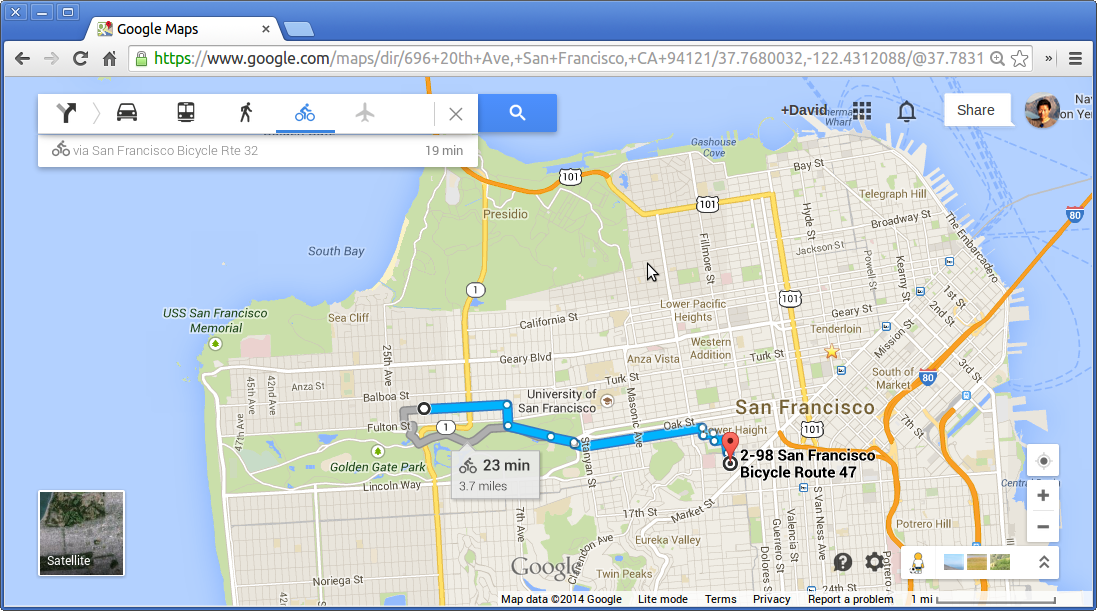
You plug in the address and map it out first. I use google maps. And it wonderfully paints a path for you in cool blue. Not necessarily a yellow brick road, but see how it wonderfully takes you from point A to point B.
Doesn't this tool give you a peace of mind?
Google Map
Clearly, a map is a wonderful guide, a reassuring helper in your journey.

Your Career

Wouldn't you like to have the same assurance in going from point A to point B in your career?
Except, what does a career map look like?
Thing is, you don't know. It is one of the axioms of life that you know with some clarity what happened in the past, but you are completely clueless about the future.
How did Google Maps know where you are going? Well, someone took measurements and made a map in the first place. In our society, we have mapmakers, or cartographers, who literally make maps.
"Stop looking at job boards. The best jobs are found or made."
A wise friend
When it comes to your career, you can look to your heroes and mentors and trace their success stories.
But, that only goes so far.
As an analogy, those examples may be like street lights in your neighborhood. Once you leave your familiar city, and head out into the wilderness, there are no lights but the stars, no paved roads.
You will have to build your own map. You may decide to later invest in paving a road.
Ancient map
A rocketing career paths are true for only a few people in the world, and is a career fallacy. And the truth seems like hard work. But, the truth sets you free to move forward toward a better and happier you.
You fear failure.
What do you do if your efforts come to nothing, if you fail? That's okay. You learn, you grow. Your map improves, and you gain little more clarity.
Every day.

In an uncertain world, be a map maker

The world is literally blowing up everyday. Technology is accelerating the cadence of change in all industries, and no job or career path is secure.
As a friend told me “focus on excellence.”
It is another way of saying invest in your value and skills. As to know how to use those skills, start building your own map, and not relying on job descriptions.
The highest paying and most valued work (where you also will feel more fulfilled and valued in your work) are not found in job boards.
My friend: “The best jobs are found or made.”
Now then, start today!

Suggestions?

What do you want to talk about?  Share your suggestions. 

Dec 27, 2013

This year, let your resolutions look back

A Story Year-ending

With a new year around the corner, people make resolutions. At year-end, people also look back and reflect. It occurred to me that one can't be prepared for the new until at peace with the past. If you are chained to the past with heavy chain, you can't run forward.

In fiction writing, resolutions aren't about making a todo list for the future. Instead, resolutions wrap up the tensions and struggles the characters experienced throughout the narrative. Whatever disappointments or complications one suffered from, there's comfort and light at the end. That's what a resolution is - to make peace with the past.

With that in mind, I don't want to make plans for the future yet. I want to remember the past year in summary and reflect whether it means a beginning or an ending.

Resolutions


1. About this time last year picked up an online Python programming tutorial - since then I explored other materials (Udacity is awesome) and learned to program. 
  • What I learned - I learned to program, which helped me appreciate technology in a different way, which helped me understand our Zeitgeist a bit differently. 
  • I also learned that the really valuable skills relating to code may not even be coding. It might be problem-solving, learning to abstract, learning to manage complexity, and learning to create re-usable modules. 
  • It taught me patience: you really can't get good overnight. All good things takes time.
2. During the last year and a half, I built a bunch of products with a friend with hopes of launching a business.
3. Read a whole bunch of stuff that I never read in business school or in my past life - Martin Seligman and Gretchen Rubin on Happiness, Thiel's essays (mind-blowing!), Paul Graham's articles, Andreesen's blogs, Noah Kagan's newsletters, Amy Hoy's Unicorn Free, Chris Gullibeau, Ferris's 4-hour book, etc.
  • What I learned - there are lots of smart people, and the possibilities for making a living in the world are really endless. In the short-run, options may be limited (because of expenses), but if you can begin to think what your passions are longer-term, rich and rewarding life-career is within your grasp. It helps to be working with smart, successful people. But, usually, you have to become smart and successful yourself to attract those people. Catch-22.
4. Wrote some cool blog posts about my experiences across business and coding in SF.
  • What I learned - I learned to communicate with readers. I'd spent a ton of my life sending email back and forth in a corporate cube. None of that stays with you. No one cares. But for the first time, I learned how to build an audience and a following; to communicate.
5. Became an author! Wrote my first e-book about Coding Bootcamps based on my insider-view experience of having worked for one and knowing bunch of people in the space.
  • What I learned - You can productize just about anything. It doesn't have to be software.
  • What I learned - You don't have to be an expert or have talent in the field (though it helps). The only talent you need is talent for action and energy. If you start, it is possible to bring others to contribute to the effort. It is the first requirement of team building.
7. Built meetup communities - Ruby Rookies and SF Product Management FastTrack (the latter with a friend, Ritu).
  • What I learned - learned what it is like to start something from nothing, how to create resources, identifying and tapping into unmet need of anonymous others, and how that leads to a community of like-minded folks.
8. Family. My younger brother got married to a wonderful wife, and my parents' cat is adorable. 
  • What I learned - We go through ups and downs. Friends sort of come and go ... and it's hard to know who is a friend until you fail. Those that are real stay with you. Family on the other hand is family. They love you and support you no matter what. They are more important than all the rest, so remember that.
What I learned - Cats are cute!

Sharing

This seems good enough place to stop. Everyone is busy, and I'm too old to keep making lists. Would love to hear from you - what your resolutions are; what you did and what you learned.

Happy New Year!

New Project

One of the things I decided to do for 2014 is to put up a new website with my own URL (since I had always used someone else's url - like this blogger.com blog). I'm going to do something constructive with it by getting non-technical MBAs more familiar with some of the tech stuff I'm playing with - sort of web101 for non-technical MBAs. It will go up on http://techproductmanager.com/. Would love your readership and support!

(If you enjoy these thoughts and would like to support my writing efforts promoting personal learning and understanding of technology, please consider supporting me through gittip.)

Sep 29, 2013

12 days 12 apps - an experiment in building and teaming

What is 12 days of coding?

It is 12 projects in 12 days. Each project would be started, finished, and shipped in a given October day.

It is an experiment in coding and learning. It is an experiment in teaming and creating a culture of doing. I will be blogging about our experience in my blog, starting with reflections about attitude over aptitude and critique of learn it quick mentality.

Appy days are Happy days

Why 12 days of coding?

Josh and I both had time to kill. But, not too much. We wanted to do something fun, build up our coding skills, and our portfolios. (The project will not always take place over consecutive days - but basically we are saying a half a month is low-risk enough to invest in an experiment ... whatever may come of it.)

And we wanted to learn: learn to be better coders, learn to be better builders, learn more about our interests. And that was it. We don't want to get ahead of ourselves.

We thought a good way to do this would be to create a set of constraints around our efforts. Constraints are key to discipline and focus.

  • One of the first choices we made was to keep it short and simple (KISS principle).
  • We are devoting around 2-weeks to this experiment.
  • We are keeping this to 2-person engineering team.
  • We are doing projects we can reasonably finish in a day.


Methodology

What about the process? No ground-breaking principles here:
  1. Build on strength - for speed, use familiar technology (for us, mostly Ruby on Rails)
  2. Prepare - for new technologies (e.g. a Node app), do some advance reading/tinkering
  3. DRY - Do not repeat yourself - look for gems wherever possible
  4. Best practices - we will use TDD; red-green-refactor; frequent commits
  5. Pragmatism - product should work; function over form (i.e. it doesn’t need to be pretty)
  6. Modularity - we will try to build templates we can reuse on subsequent days
A lot of these ideas are well-known to software engineers from works like Rework and The Pragmatic Programmer.

How you can get involved

You should join with your own mini-rapid-project(s). Do it solo. Do it as a pair. What would you like to get out of a process like this? How would you structure your efforts? Write about it and send us a link to your post or project.
Project & resources

You can find full-project page/link here - 12 appy days!

Please let me know your thoughts about attitude over aptitude and the get-rich-quick mentality that makes one-month-rails type of marketing so tempting.

Attitude over aptitude: why "I know enough code to be dangerous" is BS

"I know enough to be dangerous"

[Topic - this post relates to my thoughts about learning to code, about careers, and about attitudes people have about picking up new skills - see related post 'can you really learn to code in a month?']

"I know enough [choose your subject matter] to be dangerous" is something I never heard while living in North Carolina. It is something I often hear in and around the San Francisco.

As someone who had built a career in roles like business development and finance, I have been tempted to say similar things. However, whenever I heard someone else say it, it always seemed glib and shallow.  Call me silly, but I don't want to be shallow. Somehow, I felt I need to genuinely learn to code before I could say things like "I know enough to be..."

I'm sure you know it as well as I do. People who say things like 'I know enough to be dangerous' are either full of BS or insecurity.

Please spare us the platitudes
Attitude over aptitude

I get hung up on the details. It is my left-brain pre-occupation for patterns. I have been brainwashed for decades to learn from textbooks, or pay tuition to go to school, or to think that getting an A in a class means that you learned something.

(I reflect a bit more about this observation in 'can you learn to code in a month')

I recently shared my frustration with a mentor, Quincy: how is it that some people can seem to learn to code and start building in 3 months, while I still struggle with building more than half year out?

Quincy's advice.
Attitude over aptitude. If you take a leap and tie all your self worth in your ability to code, you will do what you need to do to get good at coding.

Of course, you are probably good at a number of other things. The key is dismissing all these other things as unimportant. During my transition, I kept justifying to myself, "I'm good at Chinese", "I can fall back on a career in operations", or "I have a business background - I'm pretty good at coding for some guy with a business background". These are traps! You have to do without an ego safety net.
Wow! It's true. The glib things we say are crutches. They are the ego's way of protecting itself for being too lazy to learn, or too afraid that we will fall and fail and look like fools trying.

Look for good people, not good tutorials

This isn't really an advice column. Instead, I hope that the experience I share here will help you learn something more about yourself and enable you to have more clarity or confidence in your walk.

So, don't take this so much as an advice as a personal observation. I found that in really learning - not just skimming over a topic, but really learning - some things are more important than others. For example, good tutorials count, maybe paying someone to give you will help. But, as I observed above, the right and sincere attitude trumps these. What else counts? People. Good books. Good ideas.

So, by all means, keep using those free tutorials, but next time also consider these:
  • Look for good people - Quincy shared an invaluable advice, because he cares. Another friend, Robert (mockdeep), has graciously been sharing his valuable time as a code reviewer and mentor on his open source project. Not all experienced professionals take interest in junior developers, or take time to invest in them. Good people do.
  • Good books / good ideas - I recently read Rework by DHH and Jason Fried (folks who built Ruby on Rails). I probably learned more about career (not just about coding) from this book than I did in two years at Darden MBA school. And at $10 a copy, it was orders of magnitude cheaper than the $100K I sunk into MBA education.
  • Right attitude - as we talked about above.
What good books and ideas are you absorbing today?

Start building

We are all apprentices in life. If you want to start learning today by building, join me and Josh as we try a 12-day-long experiment in coding and producing products.

Feel free to check out our 12days github page, contribute torepo, help us by sharing suggestions, etc.

Sep 17, 2012

A rant. Do you, or don't you? Founder Institute. How to approach resources.

Okay, so this entry is a bit of a rant.  Topic: "Do you, or don't you?"  Or how do you know or decide what's next for you?  Or reflections on using resources.  Basically, you got in.  Now what?

Here's something I often don't hear ... "Congratulations!"  An acceptance letter from Founder Institute inviting me to join its Fall 2012 SV semester class.  And they are asking me to make up my mind by tomorrow - 9/18/12 [1].


Usually, it's the "I'm sorry" letter.  Like the one after our Y Combinator interview Summer '12.  'You're good, but no dice!'  (So it goes - learning to take rejections gracefully is part of the journey - enjoy it!)


This feels a lot like B-school apps a few years ago. Got into the Darden School, rejected by others.  Now what?  And I imagine this is a common dilemma shared by other (inexperienced) entrepreneurs.  You got something (a resource), but how do you know if it's worth your investment?  And we generally suck at answering these kinds of questions about how something will pan out based on today's decision.


From Nassim's Taleb's Black Swan, Part 2 - "You would expect our record of prediction to be horrible: the world is far, far more complicated than we think, which is not a problem, except when most of us don't know it."  So we suffer from the '(wo)man who knew too little' problem.  And I know this to be true of my life.  Now and then, I catch myself wondering if my life could be better optimized.  How come I can't seem to go in one direction - up and up?


Since no one knows the future, I'm going to frame this as using resources in life.  What is a resource?  In my case, it is that which will help (our company) grow, answer questions, get users, connect to mentors, etc.  So, the useful evaluation is to determine whether FI will be useful or not for (our company).  I'm going to think about it and discuss it with my co-founder.  As a starting point, I have a few hunches about major pluses and minuses.  But, the problem with hunches is that they are almost always wrong.  And what's really needed is a more empirical data to predict the outcome.  More to come.


Some concluding thoughts to a random rant:
  1. Find/create resources.  FI is a resource.  If you don't apply or don't know about it, you don't have it.  Having a resource is the first step.  This mentality is key to creating your own luck in life.
  2. Consider the goal.  Does the resource help you achieve your goal - whether it's power, knowledge, growth, peace, whatever.
  3. Learn to reason with data.  Heuristics are easy, but unreliable.  What you want is data.  For example, I will look to FI alums to see how successful they have been ... an imperfect data point, but better than a hunch.
  4. Action trumps reasoning.  Attend info events or talk to alums to get more data points.  And will FI help me be more active or simply be an academic exercise?  For startups, key is talk less, do more.
-----
[1] By the way, if you don't know this yet, you can always change dates or rules like this one.  If you want things to work for you in life, you need to learn to change the rules to benefit you.  One useful insight to keep in mind is that whoever comes up with a rule is just another human being.  Just like you.  You can talk to them, reason with them, ask them.

Sep 27, 2009

A Perspective on Career Management

"The Darden School of Business improves society by developing principled leaders for the world of practical affairs."

That is my school's mission statement. I came to Darden in the hopes of broadening my business skill set beyond my core competencies of auditing and control. Darden offered expert assistance in this endeavor: career development center replete with printed and on-line resources, a rich tapestry of alumni, career discovery forums, company briefings, and career counselors. As my classmates and I embarked on the search, we were told to "trust the process." In summary, that process consisted of gaining an understanding of what makes one tick or what makes one happy (so called life themes) and then finding a company that could best cater to those themes. In other words, it was a two fold process of self awareness followed by matching the needs of the corporate employer. We were shown an illustration in which a twain cookie represented on the one hand the corporate needs, and on the other, individual skills and needs. The idea was to find the other half and make the cookie whole. It was understood that one may not be able to match all of the desired life themes, but more the merrier.

As I reflected on what it was that I wanted to do, why it was I came to business school, and what sort of employment I might seek, those career management sessions and illustrations came back to mind: trust the process. It struck me that in a way, Darden's career management advice espoused a very selfish worldview. Does one become a principled leader and improve society by following a career path that makes her happy? Should she seek those jobs that best cater to her desires? It occurred to me that happy workers are more likely to be productive and excel in what they do. At the same time, I felt that sometimes improving society would require one to sacrifice one's own desires and happiness for the sake of others, to aspire to a nobler cause, to heed a greater calling. If we were asked to go to war to defend our country, shall we say no because it does not fit our opinions or because it's inconvenient? Is there not a time in our lives, when we are led to do something that may not best serve our individual purpose, but which might best serve those around us?

What, then? Does this mean that all corporate careers are selfish? Are we to work pro bono? No, I think it means that as we search for the right fit, we should be aware that there's more at stake than our individual ego. In the cookie illustration, it's not the corporate half of the cookie and our half. Rather, it's many pieces, some representing our community, another representing us, another our families and friends, and so forth. There is more at stake in my career than simply money for myself, happiness for myself, recognition for myself. There is a calling to put those those talents and gifts given to us to apply it toward a fulfilling and happy career in which we can also bring greater benefit and happiness to those around us, and if we are really lucky, then the world at large. Then, I think we shall have made progress in realizing Darden's mission statement.

Jul 3, 2009

Big Picture: What is Wealth?

Now, Darden finally sent notice of loan awards. No grant, max Stafford loans, rest in Graduate PLUS loans. Oh well, at least I am grateful that I have access to loans to attend school. Better than nothing.

The biggest remaining financial hurdle is to sell my house. It's already consumed much effort (re-paint and re-carpet) and it promises yet more headaches as the market is very soft in North Carolina. Sure, it's far more robust relative to sub-prime markets elsewhere in the country, but it's still soft. The lesson to draw here are clearly to start early, very early. Also, I think you need a good agent, which mine is not. Be sure to shop aggressively and interview agents more thoroughly (and more than one) before signing.

Anyway, something else came to my mind. In particular, I thought about what it means to worry about the world, and realized there is a world apart from the world we now inhabit. I attended church last Sunday, and there were many old folks who are frail and whose days seem numbered. To the eyes, that church appears to be dying. Later that day, I came across an article about prevalence of plastic surgery in Asian countries. I'm sure there are many social forces at play, but my initial thought was that there is something morally wrong about it. I realized that using another set of eyes, the old folks who worshiped on Sunday were healthy, while a society that drives its youth to the knife for looks must be in the throes of a spiritual death. So, I must also watch out. If I don't be careful, I'll be just as lost in irrelevance instead of waiting on the Lord. It would be reactionary to simply state that plastic surgery is wrong; it isn't. At the same time, there is something not right about people who are forced to feel ugly due to some arbitrary conception of beauty, or for people who feel they must look a certain way on account of their peers, or just because they believe they must appear more comely to obtain a job, etc. Then again, that's no different from American female preoccupation with breasts size, and so forth. All of which reminds me that we really live in twisted times.

What then is wealth? Luke relates a story about Peter washing the nets by Sea of Galilee after a night of no catch. Jesus then tells him to cast his nets to the deep waters. Peter obeyed and caught so many fish that he beckoned James and John to come out to help him. Both boats were sinking, so rich was the catch. Once on shore, Peter confessed "I am a sinner." Why did he say that? Because, he realized that there is a world apart from that which he inhabited. Thereafter, it was no longer important to catch fish - though he caught many that day. Jesus took these men to make them fishers of men. World apart. Maybe it's another way of saying there is a bigger picture. For all the material wealth of this world, for all the worries about loans and this or that, there is something more important out there. I hope I'll have the humility to cast my net in the deep water when Jesus tells me to.

Jun 15, 2009

Why having goals is not sufficient: On 5 year anniversary

Recently, I marked my 5 year anniversary with the Firm. I'm not good at celebrating. It should have been a joyous occasion. Instead, it felt meaningless and empty. Still, I had lunch with a colleague with whom I had started work on the same day five years ago. That gave the anniversary a little purpose.

Five years here and I feel that I've learned little. Scratch that. I've learned quite a bit. What I've been unable to do is to market any of it. Today, I can no better go out into the Fortune 500 world and make something of myself than I could five years ago. At least outside of the accounting profession. Was it a waste?

No, but that's not the point. Don't look back. Just do something about it and move on.

I was driving back from Raleigh recently on westbound I-40. I had an epiphany. It's not enough having a goal. One thinks that by setting a goal, and working hard, that one can reach it and make something of oneself. I saw plainly before me that this is a fallacy. Just as I was blazing toward the sunset on the highway, I saw that there was an accident on the eastbound I-40; a big one. Traffic was backed up for miles upon miles. All four lanes full of smoldering cars, choking on each others' heat and exhaust and going nowhere. Wasting energy, burning fuel, frustrated, but not moving. Why were they on a highway? Because they had a goal. What was the goal? To get to the city. Fine example of pursuing a goal. And it's not enough to have a goal. How can one have a real vision that can overcome such obstacles? What can one do so that the path is more clear, more visible?

Apr 17, 2009

On Ernst & Young Feedback Process

I met with my counselor for lunch ahead of FY2009 annual reviews, also known as the round table. Over lunch, we discussed my goals, my self review, and my performance feedbacks from various engagements as a preparation for the upcoming round table.

Since I have made up my mind to leave the firm, I didn't much care for the exercise, but still took care to update these reviews, because I wanted to end my career at Ernst & Young without shame or regret. Nevertheless, I feel that MBA application process was a much more meaningful and beneficial self discovery process than reflecting on my performance as an auditor over the past year. Even if I were to disregard MBA considerations, I still find that Ernst & Young 360 feedback is faulty to the point of uselessness. In my mind, that fault primarily is due to the lack of impact of the feedback.

The firm's feedback and review process results in assigning a numerical rating of an employee against his or her peers ranging from 1 (worst) to 5 (best). The rating is supposed to follow a forced curve and allegedly directly relates to one's annual salary increase. The range of the annual raises depends on the firm's performance. For instance, if the firm announced raises ranging from 3 - 12%, then those rated 5 are most likely to receive the double digit raise. I could care less for at least three reason (again, excluding MBA considerations):

1) I think the firm's raises will suck this year - many may not even receive a raise, and those who do will see only a modest increase. This assessment is based on economy in general, but also based on local market considerations. For example, our office has lost some accounts, and our other clients have pressured for lower fees. This has to translate to either a) layoffs or b) salary freezes. We'll see both.

2) Even if you receive a rating of 5, it doesn't guaranty that your raise will be commensurate. I can vouch for instances in which my % increase as a 4 was lower than a staff who received a 3. I think the actual raise is as much based on one's current base and how much the firm thinks it can get away with, etc.

3) Even if one were to receive a high raise, I feel like the entire game is pointless to the extent that you'll always be a little fish in a small pond. Out in the industry, or for those accountants jumping around, there is always more money to be made. For example, if you were to leave and work for a competitor, you could probably negotiate a 15%+ raise verus the 5% you're likely to get for staying. If you left for industry, you might get something like 30% raise.

Now, enter MBA (with respect to salary). My current base is $62,500. If I figure about a 5% raise (I expect to receive a rating of 5 or 4), then my base will increase to around $65,500. This would be considered generous this year. If I figure two subsequent annual raises of 10% per annum (highly unlikely - in fact, will not happen), then my base would be just shy of $80,000. Now, at the same time in the Fall following graduation, my base will be in excess of $100,000, working less hours and with more prestige and more enjoyable responsibilities. Hmmm ... tough call. So, there it is, a little fish in a small pond. Of course, salary isn't the reason I'm leaving, but it's yet another validation that there is no future for me at Ernst & Young.

Given these considerations, why would someone with the ability to jump ship stay on board? In fact, we find that those who can, do not stay. If Ernst & Young wants to become a great services firm it purports to be, then it must address this weakness.

Apr 5, 2009

To Darden or not to Darden

I've been agonizing since Darden admission notice as to whether I should enroll at Darden or at Kenan-Flagler.

I've continued to speak to various folks from different walks of life to help me make a better decision:
1) Current students and recent alumni at Darden and KF
2) Business people outside of the school community - including MBAs at other schools and current, successful businessmen without MBAs
3) Friends and family - for perspective ... just as a means of stepping outside of business world to overcome myopia.

I'll share the outcomes of these conversations separately.

The more I have talked to others, I became more convinced that in the end, I really need to talk to myself. Rather, listen to myself. At some point, additional information adds only a marginal value, and may have deleterious effect. To dispel confusion, and to renew my career direction, I felt I needed to find my own voice. Hence, I paused to reconsider my chief aspirations from enrolling: 1) to learn and challenge myself intellectually and vocationally, 2) to transition to a general management role and fill in gaps in my training necessary for that transition to leadership, and 3) to build and have a brand and network to serve as a tool or a framework of support throughout my career.

1) Learning - I'm leaning Darden on this count. I believe I will learn better through the case method, and 3 quarters of team learning at Darden appeals to me more than 2 quarters at Kenan Flagler.
2) General management career - This is comparable as I believe both schools would allow me to have a broad management education. That said, I believe the case method is more conducive to training a general manager. However, I also understand that managing is not an academic exercise, so I don't know that case method has any edge here. I am leaning Darden on this attribute as I believe this is a path more established at Darden. For example, by function Darden had greater % doing GM than KF.

Darden, class of 2008 - 21%
KF, class of 2008 - 13%
(I consolidated general management, operations, strategy/development, leadership rotation programs; I excluded marketing, though I imagine there is some overlap)

3) Brand and network - I think the two schools are very comparable here, and will matter especially little as my goal is general management. If consulting, I would go with Darden. If banking, I would go with KF. As it stands, I think there is no material difference. However, I will note that more Fortune 100 companies recruit at Darden than at KF.