Showing posts with label startup. Show all posts

Jan 19, 2016

Venture Capital and Future Tech - a Reading List

Reinventing the Past

In a prior post, I wrote about my experience with a food startup.  It was a small window into venture capital, a small, but vital part of new economic growth.

I was reading a Harvard Business article about how venture capital works.  Among other things, I learned that being a good VC is about knowing how to take only those risks you can control and in the right industries (read, growing industries).

I shared the thought with an industry veteran, and his reply was that a lot of VC success is just "luck."   For instance, food delivery business only became a growth industry because VCs were pumping so much money into it.  He said:

"Anything looks good if you pump enough money into it."

Sounds plausible.  The disparity between skill and luck, and the dynamics involved in outcomes made me want to learn more.

In many ways, it's an old story about the force of technology driving businesses to become more efficient.  It's about the good enough solutions dislodging the best, because it's cheaper and easier.  Simply, consumers want it.  Yes, it's an old story, a la Innovator's Dilemma.

Tidal Forces of the Web

In Paul Ford's: What is Code? Ford notes how the profession of programming is very adaptable to change.  Languages written to solve one set of problems is often (inevitably) adopted to solve a problem in another.  For example, with V8, JavaScript could run outside of the browsers for which it was designed.  Now, it could read files, send emails, erase your data, and made the client a server.

In this "flow" of the river of software, we often observe trends toward:
  • abstraction (of information and processes)
  • adaptation (one solution applied to different use case)
  • universality (good patterns can be repeated anywhere)
  • acceleration (solutions enable other solutions)
These trends have resulted in pretty drastic power law outcomes, where you have few big winners, and then everyone else.  How should the modern professional adapt to this reality?

How You Can Keep Up - Great Books About Tech

Perhaps the easiest and the best thing you can do is to read good books.

Great books.  I was particularly interested to read more into the VC world, because it's a bridge to the traditional world of finance.  And importantly, I think it also sheds light to the financial incentives so key to driving change.

In a way, this is a contrast to the craftsman's focus on just building something great for the sake of building.  There are those whose reward is simply to build something great.  There are those whose reward is to get rich.  In our tech world, both must work together.

Tech, Future, Building

Bold: How to Go Big ... Impact the World.  By Peter Diamandis.

Tomorrowland: ... Science Fiction to Science Fact.  By Steven Kotler.

Hackers and Painters: Big Ideas from the Computer Age.  By Paul Graham.

Zero to One: How to Build the Future.  Peter Thiel.

More Strictly VC

The Startup Game: Inside ... VC and Entrepreneurs.  By Bill Draper.

Mastering the VC Game.  By Jeff Bussgang.

Venture Deals: Be Smarter than ... Your VC.  By Brad Feld and Jason Mendelson.

Jun 7, 2015

I'm hungry, and what I learned about startup investing: Is it time to eat?

It's not quite noon, and I'm hungry.  I debate whether to drum up a scramble and scour my fridge.  I'm not impressed; supplies are low.

There's a taco joint, a cafe, and a Whole Foods all within a five-minute walking distance (I'm lucky to be in a very central part of San Francisco).  But, I'm in middle of something.  Plus, I want to try something new.  Something convenient.

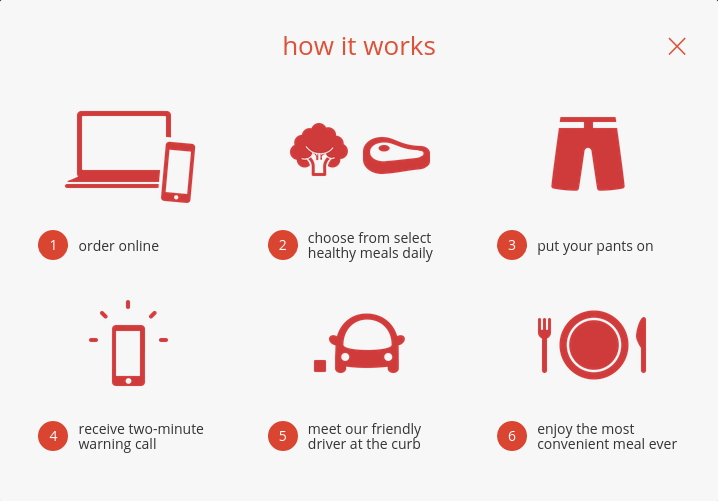
A meal from SpoonRocket is $10 bucks (including delivery and tips) and promises a fast delivery.  But what really gets me to submit an order is the humor.  Step 3 is "put on your pants."  Hey, how did you guys know?  (I wonder if I would be instructed to put on my skirts if I were a woman.)

SpoonRocket.png

I get a two minute warning text almost immediately, so I walk out to the curb.  A minute later, a SpoonRocket delivery truck pulls up, I grab a boxed lunch and I get back to my kitchen.  What did I have?  Grilled chicken apple sausage with BBQ chipotle sauce.  The meal was decent; the speed and convenience was superb.

Motivated by the positive experience and the promotion, I share the referral code on my social media and email a few friends.  My friends will get $10 bucks off when they make their first order.

Free Food


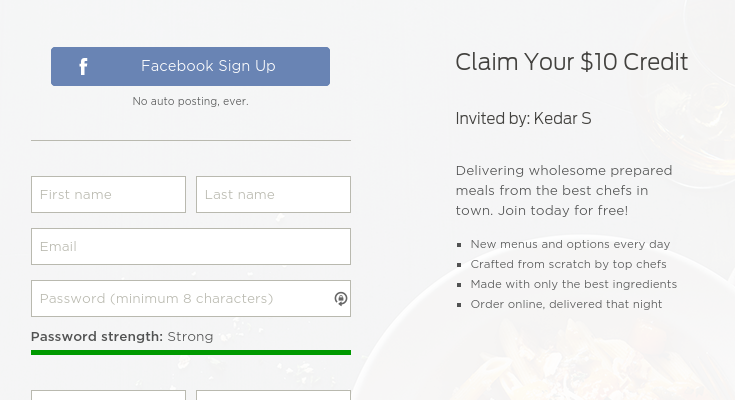
In fact, a few days earlier, my roommate had sent me an email, subject "free food."  I was invited to try Munchery and claim a $10 credit.  Whereas SpoonRocket's tagline is "Good Food Fast," Munchery promises "wholesome meals from the best chefs in town."  I guess I'll eat free tonight.

While at it, I decide to take advantage of promotions by Sprig ("Dine on Demand") as well.  And to fill up on my low running fridge, I try out Instacart.  After placing an order of groceries from a local Whole Foods (yes, the one that's three minute walk away), someone shows up in the evening with a bag of groceries at my door.  Call me a bit old fashioned, but I oddly feel obliged and sorry for the gentleman who delivered the grocery bag.  Is this how millionaires live?  Someone shops your groceries for you and cooks your meals for you.

Munchery.png

Insight Into Food Startups


This foodscapade taught me quite a bit about this food startups.  For one thing, I began to be more attentive to the space.  It turned out one of my friends worked for a team that delivers corporate catered meals.  He was paid $25 per hour to pack food.  Not bad.  But, what did I really learn, though?

1. Logistics as core UX - These companies all have to get the logistics right.  Food startups have to assemble the food, manage perishable ingredients, and deliver on time.  These companies were more like Amazon than they were like LinkedIn; more analogue than digital.

2. Engagement model - Sprig's CEO Gagan Biyani often speaks in public about growth hacking.  I once watched him give a presentation about Sprig's user lifecycle.  It shows a feedback loop consisting of "before the buy -> first purchase -> repeat purchase -> referral."  The referral leads to another "before the buy" cycle.  My own story above reflects this business model.  And this gives you an idea about where key drivers and costs of the business are.  What is the drop off from first purchase to second?  From second to third?  What are some things that can go wrong?  Try out the service once or twice, and ask your friends, and you can gain a grasp of these metrics.

3. Expensive customer acquisition - And speaking of the repeat purchase to referral, this is an expensive way to acquire new customers.  Remember that free meal I had?  Well, it wasn't really free.  It's coming out of investor's pockets, and reflects the competitive pressure and pressure to scale quickly.  By contrast, consider Intercom.io.  When I click to download a 'free' e-book, I'm asked to share 2 emails to get the free book.  That friction will lead to something less than 100% conversion, but that's a much cheaper way to build virality in my book.

4. Huge market - So, with logistics as a constraint, and expensive costs, why all the fuss about food delivery services?  Well, as a friend of mine likes to say "I'm pretty good at eating.  I do it three times a day."  And so does hundreds of millions of others.

For me, taking the product or the service for a drive and a little digging helped me put my arms around the business.  For food startups, if I wanted to learn more about the team of executives, I would expect to see some logistics or operational excellence experience: someone from Amazon or Walmart, perhaps.  I would also be keen to pay attention to emails or promotions to assess whether the team can efficiently retain a new customer.

In general, when customer lifetime value (current value of all future purchases by that customer) exceeds the cost to acquire the customer, the business is making money.  Take Munchery, for example.  It took $10 to get me to try it.  If I spend more than $10 down the road (and I did), they come out ahead.  The more profitable customers a business has, the more valuable the business becomes.

Finally, these food startups have different goto market strategies and different market constraints.  For example, if Munchery limits itself to providing food by local chefs, expanding to new cities may challenge greater logistical complexities.  By contrast, a template model of assembly simple food in a kitchen and delivering could be repeated much more efficiently.

Have fun investing!  And don’t go hungry!

More

You may also enjoy the following posts:


Aug 19, 2013

Never give in. Never? What's your dream?

Repetition => Pattern Recognition

A friend, who is studying to be a dermato-pathologist related the following story to me.  Paraphrasing:

"As a skin/cell doctor, you basically look at cells under a microscope all day.  And they all look the same (it is frustrating day in and day out).  Then, six/seven months in, something happens.  You begin to see the differences with confidence.  You can tell apart a sick cell from a healthy one, one cancerous type from another ..."

So it goes.  It reminded me of learning English as a second language when I was 10.  At first, everything sounded like the gibberish in a Charlie Brown cartoon.  Wawawa - wawa.  Then, one day (or phase of days), it falls into place.  "And there was light. And it was good."

I wonder what happens if the resident gets discouraged and gives up at month five.  Or what if it takes longer than six months to begin to have the patterns fall into place?  What if it takes longer than a year to learn a foreign language, and you still find yourself among foreigners?

image of pattern
Most patterns in life don't stand out quite so easily
(On a side note, there is a fascinating history with a 1977 Architecture book called A Pattern Language by Christopher Alexander. Some of the patterns we needn't learn from scratch - they have been documented!)

Dream vs. Reality

Of course, one could always give up on a dream - startup dream or dream to sing or whatever.  For a new entrepreneur, there are challenges galore.  Why bother?  Why not re-apply for a comfortable six figure job with a big name company?  Don't you want that nice apartment?  Don't you want that new car? C'mon, it's not giving up - you're just taking the smarter way to success.  So it goes.

Success, however you measure it, is about persistence.  And it is about learning to be resourceful (and resourcefulness can help you sell your first "lemonade").  You start somewhere, and being resourceful, you persist and make it (make what?) better every day.  Then, one day, there was light. And it was good.

As with learning a new language, it seems that sticking around and persisting really leads to result.  And just to be clear, persisting doesn't mean inflexibility.  Truth is, you will be changing your ideas and approaches all the time.  Rather, persistence is about making progress.  And the question may become more about how to optimize progress, rather than whether there will be one. So, when you become discouraged or become tempted to take the easy way out, consider stepping forward rather than stepping back.

"Never give in. Never! Never! Never!"

I admit, I don't speak entirely out of experience. Much of it is out of faith. After all, I am still learning and growing - including how to code. And I am exploring a new venture (calling it Talent Tap for now), after failing with a previous one.

I am comforted by the words of those who had faith before me.  At the risk of being overly dramatic, I find it fun to record Churchill's words from his 1941 speech at the Harrow School:


Churchill exhorting a nation to hang in there.

Doing vs. Thinking

And hitting that tipping point, where patterns come together, where momentum builds is not just about thinking and planning. Instead, it's more about iterating by doing. Sometimes it takes a bit of an attitude shift. And with that, I'm going to try 12 days of building.

Jun 25, 2013

Why do people ask: "how do you create your own luck?"?

Big Name Entrepreneurs

I was listening to Michael Wood, Aaron Levie, and Naval Ravikant tonight. They were on a Wall Street Journal panel talking on the topic: "How I Built It."  Michael is an avuncular, older entrepreneur who was a law firm partner by the time he started building LeapFrog. Aaron, by contrast is a youthful sage. At 28, he's now heading a 850 person organization called Box.  It was apparent that regardless of age, all three were very well-informed about the world, very self-aware, and very excited about what they do.  Another way to say that self-awareness and leadership is age independent.

The real deal - whiz kid

How to Create Your Own Luck

Even in the heart of startup land, people ask (what seems to me) naive questions like "How do you create your own luck?" This is a question you often hear around the startup circles.  I suspect that people have this question for various reasons, and these come to mind:

  • Misunderstanding - People misunderstand the modest statement behind success: "I was lucky"
  • Efficiency - People often find the easy way out desirable (versus relentless hard work)
  • Pattern mind - The patterns behind success stories are difficult to fathom (if there are patterns at all)
  • Role model - People genuinely want/need an inspirational story from a role model of overcoming the odds
  • Safety net - Luck serves as a mental safety net. If luck is the driver behind success, then failure is not my fault.
  • Immaturity - People just don't know better questions yet.
Some Answers

Anyway, the answer to the question generally tends to be an arithmetic one.  In Aaron's case, the story is told how he got Mark Cuban (the Shark) to invest.  The luck was created because the team hustled like nobody's business, talking to hundreds of investors.  This is a common pattern to those who successfully create traction to move forward.

Michael agreed. There are really two things: 1) Persistence and 2) Expertise.  One, you have to persist, because if you exit, then the game is over.  If you stick around and keep playing, you at least have the chance to get lucky (it is tempting to give up - I reflected on Churchill's dictum never give in in this post about persisting).  Two, it helps to know everything about the field you're in, because it helps you capitalize on the opportunity when you see it.  I think this instance of seizing the opportunity is what strikes many as luck, but it really isn't.  It is the narrative of overnight success that took 10 years to make.

And I might add, if you really want to get lucky, it really helps if you are novel.  If you know a lot about disrupting education, but so does everyone else, then it's harder to get lucky.  This is why you don't see many new startups selling insurance policies. Or why it would be hard to succeed in fields like healthcare or education: virtually everyone agrees that these industries are broken.

All of that said, don't forget to celebrate the journey - often it's not about the goal. And, when you feel like you need to get lucky, remember that it might be time to step forward, and not back.

And the journey starts with finding personal happiness and your place in the world.  If you are looking for practical tips, I wrote a post about my book on happiness.  You can find the book on Amazon - How To Be Happy: 12 Powerful Steps.

May 27, 2013

Silicon Valley's Tech Talent Hegemony Endures

How does one build a magnet for talent? It is a question equally important to cities and to teams working in cities.  One of the favorite past-times among tech people is whether Silicon Valley's glory days are over.  For example, an article recently featured on LinkedIn: "Why Silicon Valley's heyday might be over." (It stood out to me that the title suggests lack of confidence about the assertions.)  Rankings are like comfort food. They are dime a dozen (see Startup Ecosystem Report) and are like debates over religion or politics. UselessThis kind of debate misses a key point. Instead, your sole focus as an entrepreneur, a serious technologist, or political/business leader should be to focus on the attributes that produce outcomes of a successful startup hub, and decide whether you can locally produce those (or better) attributes or decide (as many do) to move to San Francisco.

Did I say San Francisco?  Well - I won't digress - it's yet another fun debate, but you can read about it in this article written by Hermione Way.

Deeper thinkers like Paul Graham get the point. In a (more confidently titled) article "Why Startup Hubs Work," PG outlines 3 factors that explain success of startup hubs: 
1) Environment,
2) Chance, and 
3) Numbers.

PG explains that #3) numbers is an underlying driver for the first two important factors. "To make a startup hub, you need alot of people interested in startups." In other words, density of right talent is a key driver for success of ideas, of innovation, of teams that capitalize on opportunities, and of successful tech companies that grow from those small teams. PG originally frames this problem in the inverse, noting that successful areas reduce the attrition rate of failure: "Somehow it's as if most places were sprayed with startupicide."

To be sure, this idea is not new. Density is a pre-requisite to ideas having sex, as elaborated in this popular TED talk by Matt Ridley.  Economist Richard Florida also studied this theme extensively and coined an entire academic sub-discipline around the Creative Class.  We, the People, have known this for millennia. When first hunter-gatherers settled into cities, all sorts of innovation happened: irrigation, plows, granary to store crops, military to protect the crops and settlements, weapons to steal neighbors' crops and settlements, rule of law to avoid such conflicts, and on and on.

What about the Internet?

Yes, internet has democratized exchange of ideas, but those outside of SF miss the simple truth. Tech people who live locally have internet AND the meetings that take offline.  Do you have that, RTP? Berlin? Vancouver?  Does your Ruby meetup group have 6,000 members and meet almost every day with dozens of organizers and hosting different events for different audience?  Do you have comparable sized communities around JavaScript, around node, visualizations, machine learning, etc?  I'm not bragging. Instead, step back and think about the causes that lead to this reality.

I'll make one more point on the effects before going back to causes. It is a cursory and high-level evidence that SF's tech hegemony will accelerate, and not slow relative to competition.

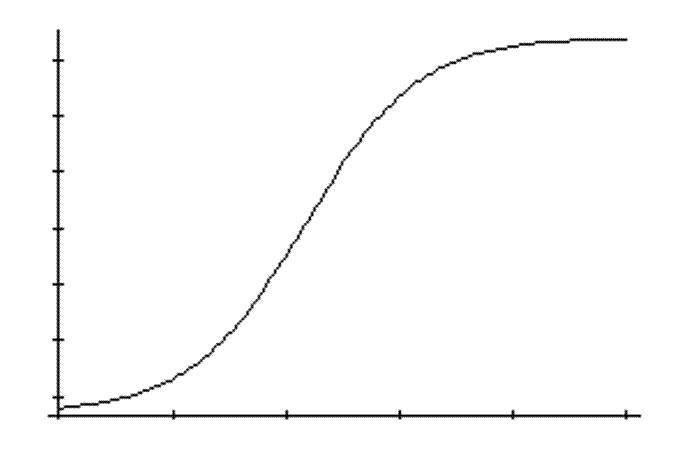
Natural phenomena generally follow a logistics curve - an exponential growth followed by inverse version flattening out to an asymptotic line:


Key question is whether we are at a turning point

Implication => If we have not reached a point where deceleration of growth has been reached, then SF will continue to outpace competition, because the growth is exponential.  If you actually live in SF, then it's not difficult to believe that we have not reached that turning point. Things are blowing up. Every day.  

Let's come back to point.  Rather than envy SF's leading position, focus on outcome and how you can also build it. Specifically, how does one build a tech talent magnet? What are the attributes that attract tech talent?  It seems at times that SF has cornered the market on this problem.

More to come

In a future post, I'll delve into what is visible and what lies underneath the visible layer.  In so doing, I will explain why features noted by critics like "high cost of living" or "fierce talent for engineers" totally miss the point.

  • How SF Tech community differs (macro-analysis)
  • Building a better (talent) mousetrap (micro-analysis)
There are some interesting implications.  For example, large companies that do not have a strong presence here may want to reconsider their future headcount investment.

Stay tuned!

Feb 10, 2013

What I Learned from George Washington About Startups and Life

Don't ask me why, but I had never read a Washington Biography.  Lincoln I had always found fascinating and devoured, but as for the first US President ... I don't know ... somehow he seemed a bit abstract and aloof and not interesting as a human being.  I was ill informed.  I found a free Kindle book on George Washington by William Roscoe Thayer on Amazon.  I was struck by parallels to the startup life, and to life in general, and wanted to share them.

from Amazon - not your average George

1. American Independence as a Hack - Persistence: Never Give Up

A lot of the epiphanies for me are a direct result of my ignorance of details the American Revolution.  For example, I knew that July 4, 1776 is celebrated as the Independence Day.  I had no idea how drawn out the actual conflict was, from Battle of Lexington and Concord in April 1775 to British surrender at Yorktown in October 1781.  And even then the war wasn't formally ended.

What is most surprising for me was how much of a hack the whole operation was during those long years.  Thayer expresses thus: "it must appear that the American Revolution was almost the most hare-brained enterprise in history."  What he means is how often the British had the chance to crush American rebellion, how long-drawn out the process was, how ill-provisioned the American opposition was.

So, then why didn't the British win?  There are many reasons.  And other founding fathers played their roles and contributed to the success.  But the primary key is Washington.  Washington was the persistent voice through all ups and downs.  Washington "never wavered" and essentially acted as the constant light while others disagreed.  Washington became a human symbol of the foundation on which the whole thing hinged and "the people knew this."  It's amazing.

Lesson: If you are fighting for a cause you believe in, don't give up.  Stay constant and true.
Corollary: Find something you believe in with all your heart.  It may not pay off soon, but over time, people will recognize your work.  Nothing great is easy, so don't give up.

(See related post where I talk about temptation to give up in my own venture - never give in.)

2. Leadership Matters

So, Washington mattered.  And he mattered supremely.  Without that one man, there might not be America as we know it today.  One man.  Stop and think about it and it's kind of amazing.  But, funny thing is, I had this sensation a few weeks ago when I watched a documentary on Vince Lombardi.  Again, I'm kind of weird for not knowing much about this American icon.  Learning about Lombardi's impact on the team - with same players - was a revelation.  Just as reading about Washington's singular contribution to victory was a revelation.

Before: In 1958, the Greenbay Packers finished with a 1-10-1 record.  On Feb 1959, Lombardi took over.
After: Well, for football fans and Packers in particular, you know the rest is history.  One man.

I attended a school, the mission of which was "to improve society by developing principled leaders in the world of practical affairs."  Come election time, I am tempted to think (as the masses often do) 'my one vote doesn't matter ... at least not much.'  And that's probably true.  But, at certain critical moments, and in leadership role, one vote, one act, one person, can and do make a profound difference.

This is Jefferson, the scholar ... beautiful Charlottesville


Lesson: The individual leader matters.  The individual matters supremely.
Corollary: In a way, every individual matters for that role.  So, hire wisely.

Hire the Washington or Lombardi for that role, so that they turn the tide of events against a bigger foe.  Help that leader turn a losing season into a championship sweep.  Neither Washington nor Lombardi became what they are overnight.  Behind their contributions stands clues to character and achievements.  It's not always the one who spoke the loudest (Adams) or had the most gleaming celebrity (Franklin) in their past that becomes that dogged, persistent, and constant figure necessary to win a long struggle.

Jul 15, 2012

4 Kinds of people (the hacker matrix)

To win in a game, in a tournament, in life, what kind of person must you be?

I saw four kinds of people this weekend at a hackathon, this one organized by the groovy AT&T Developer Program, and sponsored by the good folks at Stackmob, Tiggzi (cloud-based mobile app builder), and Amazon AWS.  I know, I just couldn't resist the free food and the vibrant energy of the crowd that gathers at these events.

And while most of us dug into our screens to play with APIs, slap together mock-ups, and code away, I saw many other kinds of people at the event.  Let me summarize in picture:

Four Kinds of People at a Hackathon
The two axes by which I categorize people are Skill and Drive.  Note that you could use other axes, but I choose these two.

  • Lo-skill, lo-effort - You are a bystander. You came to enjoy the scene and be inspired. This is okay.  But, you walk away with an empty handed
  • Lo-skill, hi-effort - You are a hustler.  It is an uphill battle.  Don't give up.  (I fall into this category.)  Dreamers have to recruit additional talent (recruit = beg for help from developers).
  • Hi-skill, lo-effort - You are qualified.  Yet, without blood & sweat, you will not be in a winning team.  Have you been part of a team of smart people that never quite achieved something of significance?
  • Hi-skill, hi-effort - Winners!  As in, these people won the day and made out like bandits with real prizes!  They had the talent; they put in the hours.
No mind-blowing insight here.  But, perhaps a sobering reminder to those not in the top-right quadrant, and want to be.  So, ask yourselves these questions today:
  1. Do I have the right skills?  Enough skills?  If not, what can I do to gain those skills? 
  2. Do I have sufficient drive or am I putting in enough effort?  If not, why not?  Am I in the wrong profession?  What can I do to figure out my passion?  
Note that I used the term "Hacker," rather than winner.  I read a great article about what is a hacker?  I aspire to be more like a hacker, in my case as an example to push myself and to gain new skills that I find exhilarating and fun.

We must all find our own paths to happiness and success.  In that walk, are you a bystander?  A dreamer?  Or will you take risks and put in the effort to realize your dreams? 


Whatever the case maybe, smile and enjoy the journey!


Smiling faces of friends remind me not to take myself too seriously

// ==========
News from the event - a team of two dashing fellows presented Voicegram, a service that allows users to send voice greetings to friends and family. It's a very nice idea to keep in touch with friends.  Check them out on Twitter to stay tuned.

If you enjoyed this post, follow me on twitter @findinbay.

Jul 8, 2012

How did Zuckerberg value Instagram?

I wondered how Facebook came up with $1B figure for Instagram.  For example, do you value Instagram based on its revenues? Or how do you get $1B from number of users Instagram had?

A few weeks before Facebook announced its acquisition of Instagram, I wrote a blog about what problem instagram solves, and concluded that there is huge value in delivering abstract stuff like beauty. Specifically, I wrote:

"Increasingly, products with the highest value offering will be those that allow people to experience beauty, meaning, transformation, values which are not forefront when more mundane problems persist. But, as people increasingly cover the 'basic needs', demand for such abstract items will rise."

This made me wonder about the valuation logic in Silicon Valley. How does a brilliant entrepreneur and hacker like Mark Zuckerberg (or Twitter's Jack Dorsey) think about valuing assets that they acquire?

I thought back to some common methods for valuing stuff in the business world.

1. Discounted cash flows (DCF) - discounts future cash streams
2. Comparables - uses similar deals as benchmark
3. Options - applies some fancy math to financial instruments ... and assumes normal distribution
4. Customer lifetime value (CLV) - tries to value the customers
5. Gut


1. DCF - From what I understand, the Wall Street-types love using something called discounted cash flows method to value an asset. Asset is anything that will make you money today or later. In short, discounted cash flows values an asset by all the money that asset might bring you today and in the future, and then "discounts" the value of all that money to adjust for inflation. (Inflation - you know, a 12 oz Coke used to be 50 cents, but is now a $1 at a vending machine.)

So, if you use discounted cash flows, Instagram value is $0. Why? Because they weren't really generating cash flows.

2. Comparables - this isn't a bad way to get a baseline. But, what other deal was like Instagram? Has Instagram been sold and traded before? Nope.

3. Options - this usually applies to trade of commodities and financial assets (remember the movie Trading Places?). No help here.

4. CLV - okay, this one is a bit more promising. (This model works well when subscription is involved - like Netflix or newspapers.) I tried to imagine Zuckerberg doing the math in his head. Let's say Instagram had about 40M users at the time of acquisition. $1,000M / 40M users = $25 / user. 
(For comparison, here's a Quora answer on the lifetime value of a Netflix customer.)

But, then think about the fact that once acquired, Instagram has access to Facebook's user base (let's round up and say it's 1 billion).  Let's do the math again. $1B / 1B users = $1 per user. A $1 per person! Do you think you could squeeze out $1 over the lifetime of a Facebook-Instagram user if you were Zuck? Do cats meow?  

Image from techi.com - 4/10/12 post

5. Gut - okay, there's not much science here.  Clearly, none of the above methods are going to give you a true answer.  I'm beginning to learn that there is a healthy amount of going by the gut in Silicon Valley.  Give it a try.  Next time you have to make a decision, try the back of the napkin, but also listen to your gut!


If you enjoyed this post, tag along for future posts on twitter @findinbay.

Jun 27, 2012

Why you need to go to a hackathon today!

Last weekend, I was hungry.  So, I went to a hackathon.  And I realized, you need to sign up for a hackathon today. What's a hackathon?  And, why should you go?

First, let me set the scene.  If you're like everyone and their grandma in the Silicon Valley, then either you're a co-founder or dreaming about building the next Facebook, Twitter, or that fancy-app-that-lets-you-share-kittie-pictures-and-get-discounts-at-your-local-cafe.  But, if you're not quite Mark Zuckerberg (yet), or don't have a comp. sci. degree from Stanford, perhaps you need to spend some time learning, building, and honing your skills.  What to do?  Go to a hackathon!

A hackathon is a gathering (a day, or a weekend, etc.) where folks come together to "hack" or "build" something together.  I recently attended one called  #News Hack Day SF  that brought hackers and journalists together.  The goal was to build tools that would enhance journalism.  This is what hackers do.  They take some existing tools at disposal to manipulate existing systems to make it better (or easier, or more profitable, or whatever you want the system to do).  In short, hackers leverage tools to innovate and improve.  Here's a picture from the event.

This is me at a recent hackathon
You'll find curious minds, great vibes, and get your own brain cells firing.  Here's what I got out of it (and more importantly, what you can get out of it.)

1. You learn cool stuff.  I learned about tools like scraper wiki and soundcloud.  Sure you might find these using google, but how would you have known what to search for?

2. You grow.  You join others who want to build.  And you might surprise yourself and build something cool.  Check out this front-end I mocked-up for Paul Osmon from soundcloud.com.

3. The people.  You encounter cool hackers and curious minds who can help you learn.  For example, I enjoyed a presentation by a designer named Sha, who talked about "visceralization."

4. The energy.  There's something about the buzz in the air, of curious minds coming together to build something.  It's inspiring and you should experience it!

5. Freeeeee food!  Check out my instagram pic of a bad-as$ breakfast.  Free!  Hungry for a hackathon?

6. And free stuff.  For example, check out this cool T-shirt from a recent  @testthewebfwd session.


Look at this beauty from a hack event.  Want one? 
If nothing else, you can chill at a cool space.  Our hackathon was in a cool shared space called Hub SOMA.  Check out the awesome yellow leaf hammock in action by my friend Joe.

Cool dudes hanging out at cool hackathon
So, how much does it cost?  How do you sign-up?  Stay tuned for another post where I share some great tips to get you going.

Jun 26, 2012

When all else fails, run! [insert your name here]! Run!

The other day, I was feeling stuck.  Stuck on trying to solve a CSS display issue.  Stuck on trying to come up with a new business idea with a friend.  Stuck on making a progress in my learning.  Feeling stuck about what to do next today.  Feeling stuck in life.

And I tried to take a deep breath.  It didn't work.  And I tried to get up and pace around a bit.  It didn't work.  And I brewed some coffee (Starbucks) for a caffeine injection.  It didn't work.  So, what do I do when all else fails?  Run!  Literally.

Picture of a friend running the Blue Ridge Relay
Running takes my body and my mind away from the problem at hand, and helps me get unstuck from the space and problem in which I'm immersed.  Sure, I am tempted to stick it out.  Sure, running can feel like running away.  But, sitting in front of the computer screen for another hour wasn't going to produce anything useful.  Instead, running for an hour had all sorts of benefits.  [For a more authoritative list, I dug up this article from a running magazine: Why running is good for your body.]

As for me, here's what I got:
1. Pulverized calories and felt great from sweating them off.
2. As the muscles burned, I got a jolt of awesome hormones, like endorphin and dopamine.
3. More importantly, running freed my mind from what was bugging me. I felt grateful that I could run.
4. I am grateful to feel the breeze on my face.  I am grateful to see birds and trees.  I am grateful to breathe!
5. I thought about life beyond the computer screen. While I get stuck from time to time, life is more than staring at a screen.  Life is more than making a buck.  Life is more than getting ahead.
6. I felt grateful to be alive.  Sometimes, I feel frustrated that I'm not this or that, that I don't make this or that, that I'm not more, more, more.  But, hey!  Life is still pretty damn sweet.

And when I came back home, I was happy.  And I couldn't remember what was bugging me so much.  Life goes on.  Life is good.

If you are looking for other ideas on how to get out of a rut, checkout my post about going to hackathons here.