Showing posts with label web. Show all posts

Jun 7, 2014

Hotel Tonight teardown: trigger and room analysis

Background - Triggers

This week, I have been reading a book called Hooked, which is about building habit forming products by Nir Eyal (who also writes about it in his blog nirandfar.com).
In this post, I take a quick-pass analysis of an email I got from Hotel Tonight, an email which was an external trigger to goad me to act. The focus is not so much on habit formation, as general product and trigger observations.
A lot of us go through the day and do things automatically, because we have been conditioned to do so. The first step to such conditioning is a trigger. To use an example (from the book), before you became addicted to Instagram, you first became aware through an external trigger, such as an Instagram picture posted on your friend's Facebook wall. Once you become a regular user, you find yourself opening Instagram to capture and share a beautiful moment. This describes a transition from external to an internal trigger. Instagram has got you! As the saying goes: “we are what we repeatedly do.”

Hotel Tonight Email Trigger

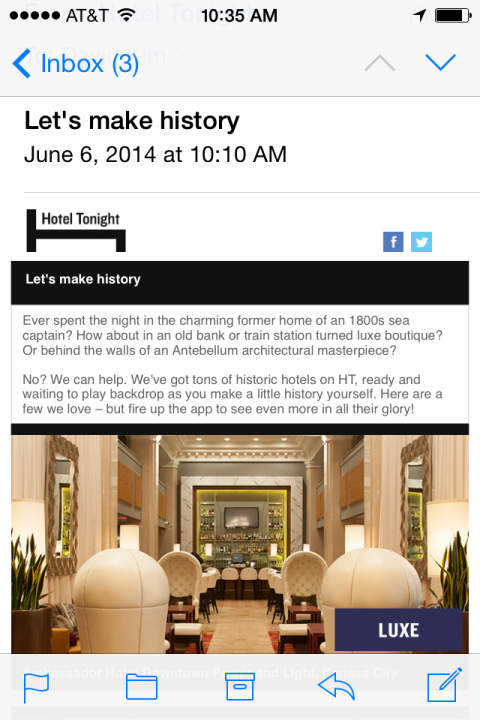
So, Hotel Tonight sent this email, and I woke up to it in my inbox.
HT email 1
Email: Hotel Tonight
Notice the copy language used. “Let's make history” and the last sentence “fire up the app to see even more …” Clearly, the language is intended to move you to act.
It is also clear, the big emphasis is on visual language. The first image is a beautiful perspective of a luxurious hotel lobby looking into a high-end bar. It beckons your aspirations - “would you not want to walk into this stylish, high life?” - the image suggests.
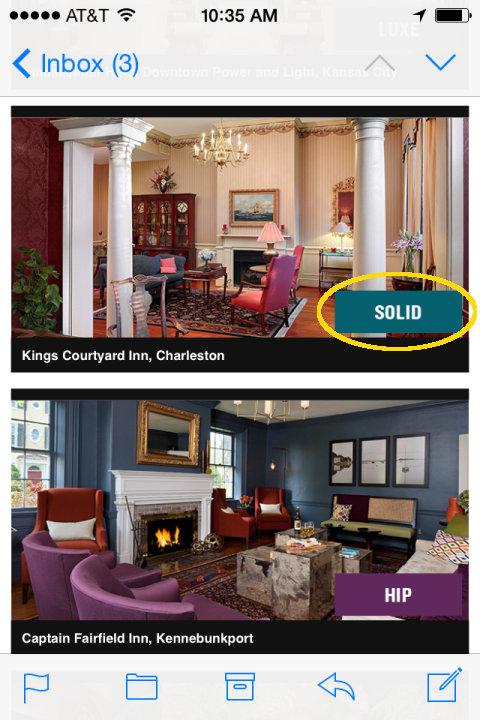
As you scroll down, you see different hotel room types. In the following two room types, you notice the box in the lower right corner “HIP” and “SOLID (yellow circle).”
HT email 2
HIP and SOLID rooms
Alright. My curiosity sufficiently stoked, I open the mobile app. The email trigger successfully lead to action.
HT email 3
Room types and images are complemented with room prices.
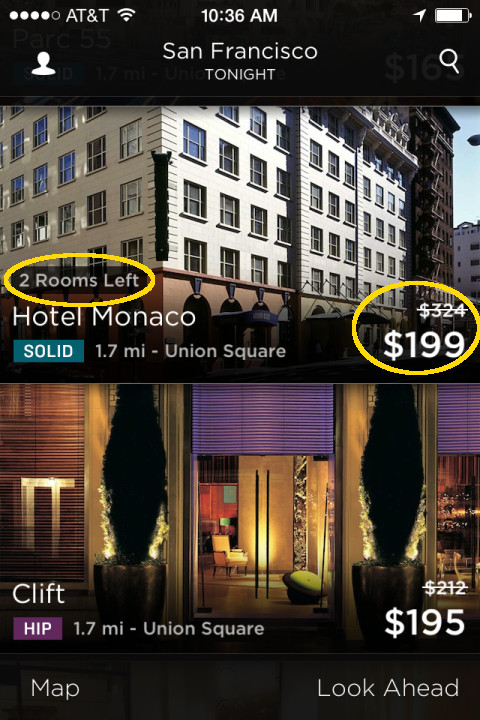
You can find a few techniques in the image above intended to move the rooms (i.e. action triggers).
  • The first is bargain hunting. See how the room price has been cut from $324 to $199.
  • The second is scarcity. Notice that there are only 2 rooms remaining at Hotel Monaco. Get this room now before it is sold out!

Room Categories Confusion

I have to say that I am puzzled by the product team's decision around room categories.
  • First of all, how should the user decipher the room categories and the colors? Does the intended user use the app often enough to be able to associate the colors with the categories?
  • Are the catgory names themselves intuitively defined? I had no idea what “SOLID” meant. I fumbled around the app to find what it means in this next screen shot.
HT SOLID
Solid is a comfortable, reliable hotel with all the gotta-have-em amenities.
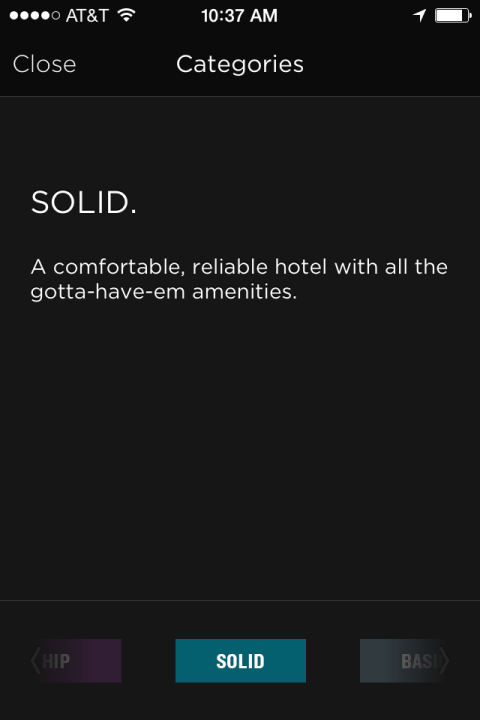
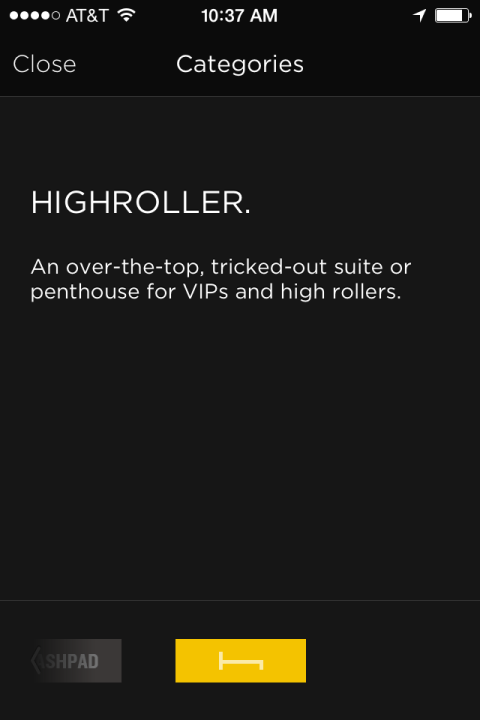
There is another categeory called Highroller. Once again, you kind of know what this means, but not really.
HT highroller
This is not me. Is it you?
So this brings up all a few questions:
  • What problem is the product manager trying to solve with these categories?
  • Is HT currently serving room types based on past user transaction history or generically?
  • If the intended action is click, are the room categories an effective trigger?
  • How does the color coding relate to UX?

Compare Airbnb

Compare Airbnb. If the catgories are intended to trigger something, it is interesting to note that Airbnb approaches this problem narratively: “You'll enjoy city at Loft in Nature.”
HT Airbnb landing
Airbnb landing page.
The aspirational imagery subtly leads to an internal trigger. Next time you think about vacation, you may find yourself going to Airbnb to browse.
One final question for both Airbnb and Hotel Tonight is, given the observation that human beings attract attentionwhy are people missing from the picture?
Imagine that top image, with an attractive bartender staring squarely at you, or the Airbnb deck, with a playful gal sipping from a cup, living the good life. Now, wouldn't you like to be there?

More

If you liked this post, you may want to try a comparative mobile app teardown screenshots forAirbnb and Hotel Tonight. Give it a try, annotating what you see in detail, and improve your product sense in the process.

You may also enjoy the post of test drive of Assembly product.

May 27, 2013

Silicon Valley's Tech Talent Hegemony Endures

How does one build a magnet for talent? It is a question equally important to cities and to teams working in cities.  One of the favorite past-times among tech people is whether Silicon Valley's glory days are over.  For example, an article recently featured on LinkedIn: "Why Silicon Valley's heyday might be over." (It stood out to me that the title suggests lack of confidence about the assertions.)  Rankings are like comfort food. They are dime a dozen (see Startup Ecosystem Report) and are like debates over religion or politics. UselessThis kind of debate misses a key point. Instead, your sole focus as an entrepreneur, a serious technologist, or political/business leader should be to focus on the attributes that produce outcomes of a successful startup hub, and decide whether you can locally produce those (or better) attributes or decide (as many do) to move to San Francisco.

Did I say San Francisco?  Well - I won't digress - it's yet another fun debate, but you can read about it in this article written by Hermione Way.

Deeper thinkers like Paul Graham get the point. In a (more confidently titled) article "Why Startup Hubs Work," PG outlines 3 factors that explain success of startup hubs: 
1) Environment,
2) Chance, and 
3) Numbers.

PG explains that #3) numbers is an underlying driver for the first two important factors. "To make a startup hub, you need alot of people interested in startups." In other words, density of right talent is a key driver for success of ideas, of innovation, of teams that capitalize on opportunities, and of successful tech companies that grow from those small teams. PG originally frames this problem in the inverse, noting that successful areas reduce the attrition rate of failure: "Somehow it's as if most places were sprayed with startupicide."

To be sure, this idea is not new. Density is a pre-requisite to ideas having sex, as elaborated in this popular TED talk by Matt Ridley.  Economist Richard Florida also studied this theme extensively and coined an entire academic sub-discipline around the Creative Class.  We, the People, have known this for millennia. When first hunter-gatherers settled into cities, all sorts of innovation happened: irrigation, plows, granary to store crops, military to protect the crops and settlements, weapons to steal neighbors' crops and settlements, rule of law to avoid such conflicts, and on and on.

What about the Internet?

Yes, internet has democratized exchange of ideas, but those outside of SF miss the simple truth. Tech people who live locally have internet AND the meetings that take offline.  Do you have that, RTP? Berlin? Vancouver?  Does your Ruby meetup group have 6,000 members and meet almost every day with dozens of organizers and hosting different events for different audience?  Do you have comparable sized communities around JavaScript, around node, visualizations, machine learning, etc?  I'm not bragging. Instead, step back and think about the causes that lead to this reality.

I'll make one more point on the effects before going back to causes. It is a cursory and high-level evidence that SF's tech hegemony will accelerate, and not slow relative to competition.

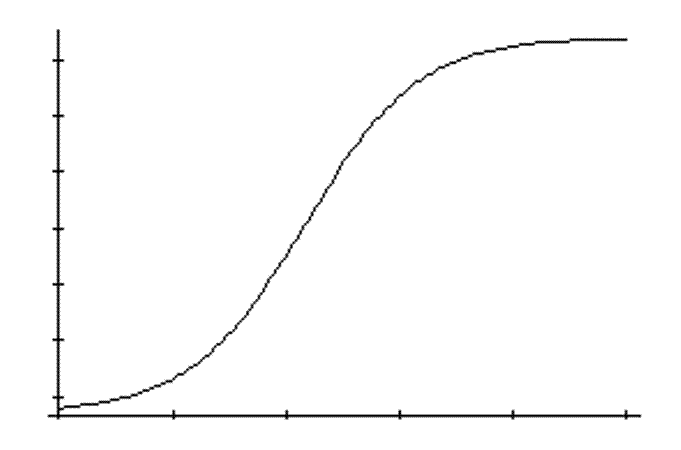
Natural phenomena generally follow a logistics curve - an exponential growth followed by inverse version flattening out to an asymptotic line:


Key question is whether we are at a turning point

Implication => If we have not reached a point where deceleration of growth has been reached, then SF will continue to outpace competition, because the growth is exponential.  If you actually live in SF, then it's not difficult to believe that we have not reached that turning point. Things are blowing up. Every day.  

Let's come back to point.  Rather than envy SF's leading position, focus on outcome and how you can also build it. Specifically, how does one build a tech talent magnet? What are the attributes that attract tech talent?  It seems at times that SF has cornered the market on this problem.

More to come

In a future post, I'll delve into what is visible and what lies underneath the visible layer.  In so doing, I will explain why features noted by critics like "high cost of living" or "fierce talent for engineers" totally miss the point.

  • How SF Tech community differs (macro-analysis)
  • Building a better (talent) mousetrap (micro-analysis)
There are some interesting implications.  For example, large companies that do not have a strong presence here may want to reconsider their future headcount investment.

Stay tuned!

Dec 11, 2012

Language is for communication - or the guy who started coding at 5

Should you learn to code?  Why?

If you're not already a developer, should you bother to learn some programming?  I am an MBA-guy learning to code, because it's fun.  Still, I sometimes wonder "why am I doing this?"  And I found many non-developers share this question.  I initially thought about this in terms of career advancement.  Then, I got wiser.

In a prior entry, I observed a trend: coding is coming to the masses.  At least the demand for learning to programming appears to be accelerating.  (Have you noticed this trend?)


Just an old geezer talking

First, a brief history.  When I applied to business school, there were no channels or organizations like Coursera.org or App Academy.  Second, I am learning to code to expand my prototyping tool-set.  Third (this is an important motivation for me), I want to better appreciate technical co-founder and his talents.

And I have no illusions about become a serious developer overnight.

On that last point - illusions - I have often heard some say: "I don't code, but I know enough to be dangerous."

Really?  Dangerous, how and to whom?  The more I learn, the more I find how hopelessly harmless I am, and will continue to be for a long time.  Then again, they may be right.  I can see how bad code can harm the world.


Conventional wisdom focuses on career

When I google something like 'why everyone should learn to code,' I come across an article like this one from VentureBeat (9/17/12 article by Jolie O'Dell).  The outline of this and many similar articles might run something like:
  • Programming literacy is important. (It's the same reason people around the world learn English - because it's the lingua franca of commerce.  It makes you a world-smart citizen.)
  • It's a good way to improve problem solving skills, etc. (It will make you smarter, which is inherently good.)
  • It's going to be good for your career, because [insert some bull-shit reasons].  (You'll make more money $$$.  Maybe.)
I was more intrigued by the well-known article by Marc Andreesen on Why Software Is Eating the World.  It is a good article, and you should read it.  Andreesen built Netscape.  I was in high school then, and I still remember the weird monochromatic browser-thing I saw on huge Unix stations at school, and nerdy kids at school staring at it into the night (I attended a public boarding school).

"I was coding since I was 5"

Incidentally, some of those nerdy kids I saw late night have been coding since they were young.  Really young.  And they didn't just code into late night.  They coded on weekends.  They coded during football games.  They "skipped" prom.  (Incidentally, I never went to the prom either.)

I recently talked to a developer who claimed he was coding since he was 5.  And I'm pretty sure, soon, I will meet someone who started coding while during the third trimester in his mama's womb.

What programming really is

The point is that if you're just catching onto the coding trend, and want to learn "just enough to be dangerous," good luck!  I'm not stopping you.  And I am not writing this to dissuade you from making yourself better.  It's not going to stop me from learning.  But, consider this.

Language is a tool for communication; it is a tool for expression.  At some level, programming language are used by those who know it best to express their individuality.  They express themselves:

  • To explore personal interests
  • To build tools for personal use
  • If they so choose, to express or share those interests or tools with the rest of the world
  • And if they are lucky, to make the world a better place and make lot of money doing it
  • And it's okay if they don't make a hit ... they will keep coding and keep doing things for themselves anyway.
This is a fundamental insight that is seldom found among those advocating coding literacy.  This insight is also often missing from professionals picking up coding so that they can be "dangerous."  

By all means keep learning.  Literacy is a good thing whether or not you are the next Charles Dickens.  However, understand that a language is a medium of expression.  Just remember that your best means to express yourself to the world may be a musical instrument, or through sports, or just plain 'ole English.

Further reading

Incidentally, you may want to attend a hackathon to see first-hand what all of this coding and startup buzz is about.  Or if you are wondering about attending a full-time programming course, check out this guide I co-wrote: Guide to Full-Time Programming Course.